
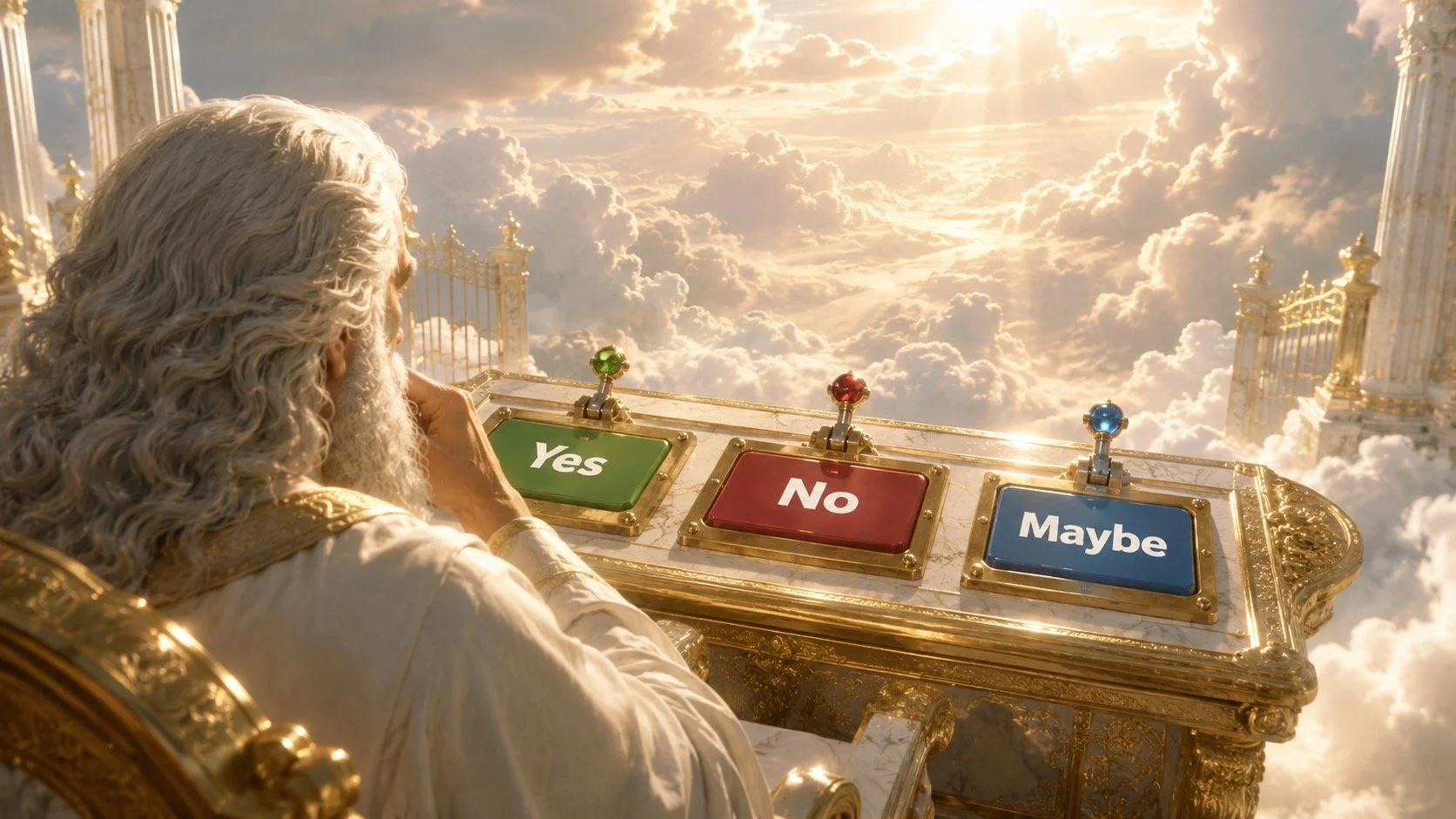
Does God Change His Mind?: Yes…No…Maybe?
Some questions sound simple until you actually try to answer them. Then you realise they are less like a tidy little theological puzzle and more like trying to untangle Christmas lights that were clearly packed away by someone who wants to make you suffer. Too soon for a Christmas reference?
“Does God change his mind?” is one of those questions, so don’t expect me to have a nice tidy completely satisfactory answer in this short article, but I’m going to give it a crack anyway.
You see, in number of places in the Bible, God seems to change course. Moses prays, and God relents from judgment. Nineveh repents, and God does not bring the disaster Jonah preached about. Hezekiah prays, and his life is extended. There are moments where God seems to respond, reconsider, relent, and act differently because people pray, repent, or cry out to him.
But then, on another page, the Bible says God does not change. “I am the Lord, and I do not change” in Malachi 3:6. “God is not a man, so he does not lie. He is not human, so he does not change his mind” in Numbers 23:19. Then Hebrews 13:8 tells us, “Jesus Christ is the same yesterday, today, and forever.”
So which is it?
Does God change his mind?
Yes. No. Maybe.
Helpful, I know...stick with me.
God Is Not Making It Up As He Goes Along
Let’s start with the “no.” God does not change like we do. He is not learning on the job. He is not reacting to new information. He is not sat in heaven saying, “Well, that escalated quickly.” God has never had to pretend he knew something when really he was just nodding along and hoping nobody asked a follow-up question.
When the Bible says God does not change, it means his character is steady. His goodness does not have off days. His love does not run out. His holiness does not fade. His promises do not go past their use-by date. His wisdom does not need an update, a patch, or a quick restart.
That is incredibly good news, because a changeable God would be terrifying. Imagine praying to a God who was merciful on Monday, grumpy by Wednesday, and by Friday had decided to completely rethink the whole salvation thing. You would never know where you stood. You would spend your whole life trying to catch God in a good mood, which, let’s be honest, is exhausting enough with people.
But the God of the Bible is not like that. He is faithful because he is faithful, its his nature. He is loving because he is loving. He is holy because he is holy. He does not become more gracious when we impress him, and he does not become less gracious when we are a bit of a spiritual car crash.
God does not change in who he is.
But God Really Does Respond
Here is where it gets interesting. The Bible also shows us that God is not cold, distant, or detached. He is not a divine vending machine where we insert prayer and wait for the correct blessing to drop. He is personal. He listens. He warns. He grieves. He delights. He disciplines. He shows mercy. He responds.
In Exodus 32, Israel makes the golden calf almost immediately after God has rescued them from Egypt. It is one of the great “you had one job” moments in the Bible. God has delivered them, fed them, led them, revealed himself to them, and their response is basically, “Wonderful, let’s build a cow to worship.”
God speaks of judgment, but Moses intercedes. Moses pleads with God to remember his promises and show mercy to his people. Then Exodus says that God relented from bringing on them the disaster he had threatened.
That sounds very much like God changing his mind.
Then we get Jonah. God sends Jonah to Nineveh, a violent and wicked city, to announce judgment. Jonah does not want to go, partly because he hates Nineveh, and partly because he knows exactly what God is like. Eventually, after the whole fish situation, which is a fairly dramatic example of God saying, “Shall we try that again?”, Jonah preaches to the city. Nineveh repents, and God shows mercy.
Jonah is furious. Not because God has acted out of character, but because God has acted exactly in character. Jonah basically says, “This is why I ran away. I knew you were merciful and compassionate. I knew you were slow to anger. I knew you were full of unfailing love.”
That is the key. God did not change from angry to kind as though his personality had shifted overnight. Nineveh changed direction, and God responded with the mercy that had always been in his heart.
When The Situation Changes, The Response Changes
A simple way to understand this is to think about a parent and a child. If a parent says, “If you keep doing that, you’re going to lose your phone,” the goal is not necessarily to take the phone away. The goal is to protect your child from doing whatever ridiculous thing they were doing, which, if you have teenagers, could be almost anything from winding up a sibling to trying to cook a mini pizza in the toaster like a tiny hormonal arsonist.
If the child stops, apologises, and changes course, the parent may not take the phone away. Did the parent change their mind? In one sense, yes, because the outcome changed. But did the parent become inconsistent? No. The warning worked. The parent’s character stayed the same.
I think that is often how God’s warnings work in Scripture. They are not always final words of doom. Sometimes they are merciful alarms. God warns people because he wants them to turn around before they hit the wall.
Jeremiah 18 makes this very clear. God says that if he announces judgment on a nation and that nation turns from evil, he may relent from the disaster he had planned. And if he announces blessing but that nation turns to evil, he may reconsider the good he intended.
In other words, some of God’s announcements are relational. They are designed to provoke a response. God’s warnings are not always him saying, “This is definitely happening no matter what.” Sometimes they are him saying, “Turn around, because this is where this road leads.”
So when people repent, pray, or turn back to God, the situation has changed. And because God is just, merciful, holy, and faithful, his dealings with them may change too.
God’s character does not change. But his response to people can change because the relationship is real.
What About God Knowing Everything?
This is where the question gets proper chewy! If God knows everything, how can he ever change his mind? Surely changing your mind means you have discovered something you did not know before.
I change my mind when I check the weather and realise leaving my coat at home was a tragic mistake. I change my mind when I see the price of something and suddenly decide I did not need it after all. I change my mind when my wife gives me that look which means, “I trust you to make that decision, but I would strongly advise against it.” (she is usually right..not always, but always worth taking seriously)
But God does not change his mind because he has received new information. God knows the end from the beginning. He is not surprised by our prayers, our repentance, our bad decisions, our tears, or our return. He is never caught off guard.
From our side, life unfolds moment by moment. We pray, and God answers. We repent, and God forgives. We rebel, and God disciplines. We cry out, and God draws near. We intercede, and God shows mercy. These things are real. They are not pretend. Prayer is not religious theatre. Repentance is not a pointless hoop to jump through. God genuinely relates to us within history.
From God’s side though, none of it is unexpected. His eternal purposes include the real prayers, real choices, real warnings, real repentance, and real mercy that unfold in our lives. God does not only ordain the destination; he also works through the road that gets us there.
So prayer matters, not because God is forgetful, or manipulatable, but because God is relational.
The Bible Holds Both Together
The Bible does not seem embarrassed by this tension. In fact, sometimes it puts both truths right next to each other.
In 1 Samuel 15, we are told that God regretted making Saul king because Saul had turned away from him. Then, in the same chapter, Samuel says that God is not a man that he should lie or change his mind. At first glance, that feels like the Bible has contradicted itself before the kettle has even boiled.
But the point is not that God is confused. The point is that God is not changeable like Saul. Saul is unstable, proud, fearful, and disobedient. God is not. God’s grief over Saul’s rebellion is real, but God’s character and purposes remain steady.
God can be genuinely grieved without being uncertain. God can respond within history without being surprised. God can relent from judgment without becoming unreliable. God can interact with people without losing his sovereignty.
That might stretch our heads a bit, but it should comfort our hearts.
So, Does God Change His Mind?
Yes, if by that we mean God genuinely responds to people. He hears prayer. He honours repentance. He shows mercy. He relents from judgment. He is not a stone statue in the sky or a distant force with no emotional investment in the people he has made.
No, if by that we mean God changes like we do. He does not learn new facts. He does not realise he was wrong. He does not panic, overreact, or have to go back to the drawing board. God is not revising his plan with a red pen and a slightly stressed look on his face.
Maybe, because the phrase “change his mind” can mean different things. If we mean God’s character changes, then absolutely not. If we mean God’s dealings with people can change when they repent, pray, or rebel, then yes, Scripture shows us that again and again. Not to mention, that if this weren’t true then the gospel would hold no value at all!
The beautiful balance is this: God is unchanging in who he is, but because of who he is, he genuinely responds to us.
That means we can trust him completely and still pray boldly. We do not pray because God needs updating. We pray because God has invited us close. We do not repent because God enjoys making us squirm. We repent because God is merciful. We do not trust him because we understand every mystery. We trust him because his character is steady even when our understanding is not.
God is not moody. God is not mechanical. He is faithful, holy, merciful, personal, and near.
He is the same yesterday, today, and forever.
And because he is the same, he still hears, still warns, still forgives, still restores, and still welcomes us home.