
Why Do Christians Talk Like Weirdos? 10 Confusing Things Christians Say
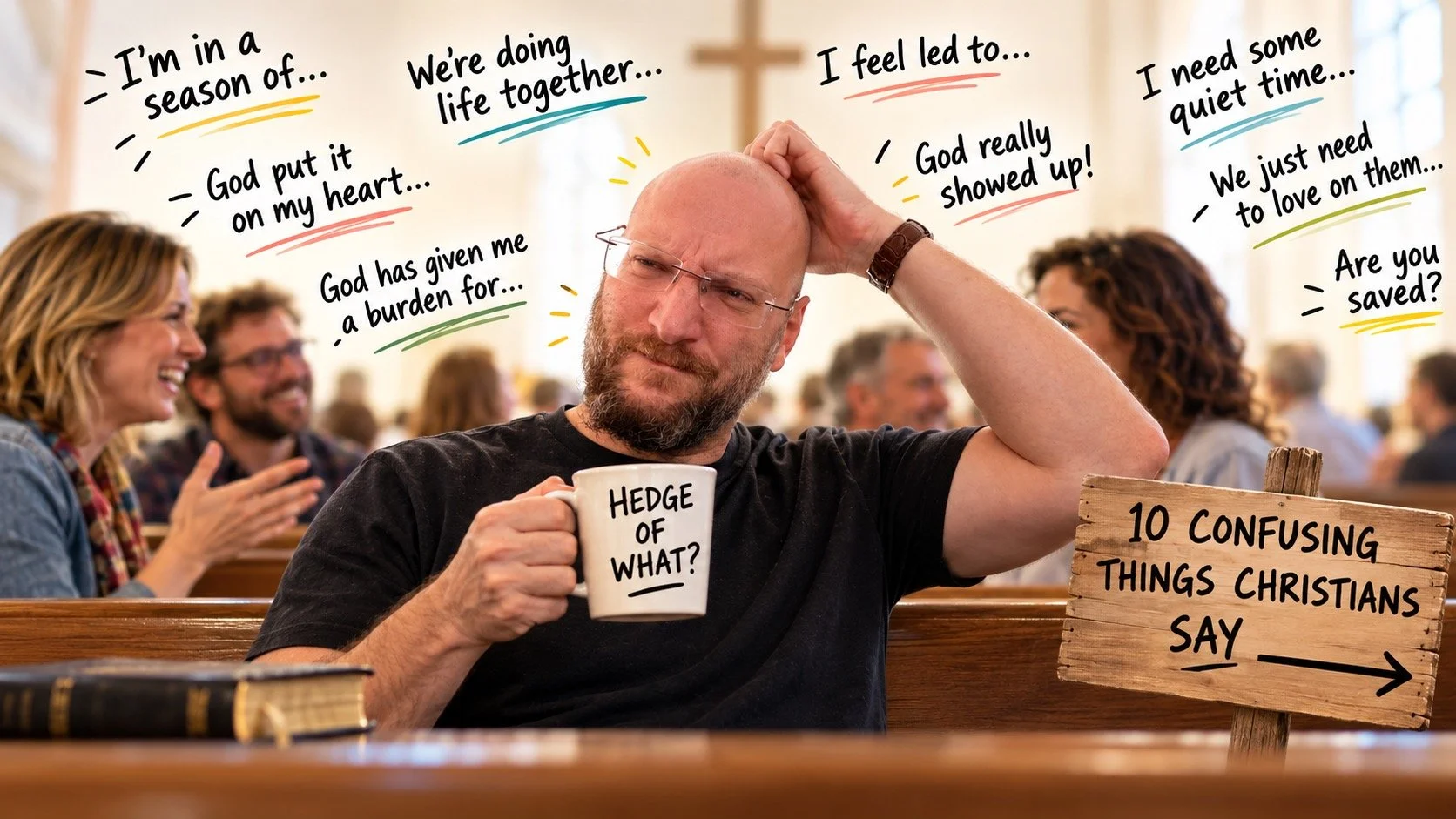
Christians say some weird stuff. I know because I’m one of them.
I’ve been around church long enough that I can comfortably talk about being “in a season”, “feeling led”, needing some “quiet time”, having something “put on my heart”, and asking God for a “hedge of protection” without giving any of it a second thought.
But imagine walking into church for the first time. You don’t know where to sit. You don’t know when to stand up. Someone has already hugged you despite you quite clearly going for a handshake. Then the person next to you starts praying for God to surround you with a hedge.
A what? Are we praying or landscaping?
The problem isn’t that these phrases are bad. Some are rooted in biblical ideas and can be genuinely helpful ways of describing our experience of God. The problem comes when meaningful language becomes meaningless jargon, or when we use Christianese to make ordinary things sound more profound and spiritual than they really are.
“I’ve been thinking about this” becomes “The Lord has put this on my heart.” “I’m having a difficult time” becomes “I’m walking through a season.” “I think we should help them” becomes “God has given me a burden.”
Sometimes we need to put down the Christian Word Expander 3000 and just say what we mean.
1. The Hedge of Protection
“Lord, put a hedge of protection around Dave and his family.”
Lovely sentiment. Slightly questionable security arrangements.
I’ve seen a determined Jack Russell get through a hedge in eleven seconds.
The biblical idea of God surrounding and protecting his people is beautiful. The problem is when the phrase becomes a magic formula we repeat without thinking. Instead of automatically deploying the hedge, why not pray what you actually mean? “God, keep them safe. Give them wisdom. Protect them from harm.”
Prayer doesn’t become more powerful because we’ve added shrubbery.
2. The Quiet Time / The Secret Place
A “quiet time” simply means intentionally spending time praying, reading Scripture and being with God. Brilliant. Jesus regularly withdrew from the crowds to pray.
But we can turn a life-giving discipline into spiritual homework. “Have you done your quiet time?” can start sounding like God is taking attendance and somebody forgot their PE kit.
Prayer matters. Scripture matters. Regular time alone with God matters enormously. But perhaps around someone unfamiliar with church language, just say, “I spent some time praying and reading the Bible this morning.”
They’ll know what you’re chatting about.
3. God Put It on My Heart
Sometimes this describes something very real. You’re praying and a person, situation or idea keeps returning to your thoughts. You genuinely sense God prompting you to act.
But this phrase can also become Christian diplomatic immunity.
“God put it on my heart.”
Well, discussion over then.
Because now disagreeing with you sounds suspiciously like disagreeing with God.
Sometimes God prompts us. Sometimes we’ve had a good idea. Sometimes we just really want something. There’s enormous humility in saying, “I think God might be prompting me towards this, but I could be wrong.”
4. I Feel Led To...
Christians feel led to do an impressive range of things. Change jobs. Move house. Leave churches. Start ministries. Buy cars.
“I really feel led towards the model with heated seats.”
Do you, Ian?
God genuinely guides his people, but “I feel led” shouldn’t become a get-out-of-wisdom-free card. God’s guidance doesn’t remove our need for Scripture, prayer, wisdom and other Christians.
Sometimes one of God’s greatest gifts is a friend who listens patiently to our deeply spiritual explanation before saying, “Mate, I love you, but that’s a terrible idea.”
5. Doing Life Together
Christians don’t have friends anymore. We “do life together”.
What we mean is actually beautiful. Christian community should involve knowing, encouraging, supporting, forgiving and challenging one another.
But sometimes “doing life” just means spending time with people who are exactly like us. Same age, same background, same opinions, same coffee order.
The early church was remarkable because Jesus created family between people who wouldn’t naturally have chosen each other. Christian community isn’t extraordinary because we enjoy spending time with our mates.
6. I’m in a Season Of...
Don’t get me wrong, this one is legitimately helpful at times, but some Christians have more seasons than Netflix.
Waiting. Growth. Rest. Transition. Realignment. I’m waiting for someone to announce they’re entering a season of photosynthesis.
But “season” can be a beautiful idea. Ecclesiastes reminds us that life changes. What you’re experiencing today isn’t necessarily forever.
Just don’t let the phrase hide what’s actually happening. “I’m in a difficult season” might really mean, “I’m lonely.” “I’m grieving.” “My marriage is struggling.” “I’m exhausted.”
Sometimes plain language requires more vulnerability than spiritual language.
7. God Has Given Me a Burden For...
“This is Steve. God has really given me a burden for him.”
Cheers.
Lovely to meet you too, Steve.
A “burden” usually means a deep concern for a person, group or situation, and compassion that moves us towards prayer and action is a wonderful thing.
But we don’t need to supernaturalise every interest. Maybe God has given you a burden for youth ministry. Or maybe you really enjoy working with teenagers. That’s allowed.
And if you do genuinely feel called to care for someone, perhaps don’t describe them as your burden while they’re standing next to you.
8. God Really Showed Up
The worship was amazing. Everyone sang. Someone cried. The music built.
“God really showed up.”
I understand what we mean. Sometimes we become particularly aware of God’s presence and activity.
But where was He beforehand? Stuck in traffic? We dont need to invite an omnipresent God into our meetings, he is already there, that’s what omnipresent means. Instead, we need to lay aside our own agendas, emotions and anything else that distracts us & enter into what he is already there to do.
We should be careful not to confuse our emotional response, with the reality of God’s presence. God might be powerfully at work during an ordinary Sunday when nobody cries and the projector breaks. Our emotions are not unimportant, but they are also extremely unreliable measures of Gods presence.
No swelling music? No goosebumps? God is still there.
9. We Just Need to Love on Them
Please don’t, infact, I insist you keep your love off me. Just love me you weirdo!
What we mean is excellent: care for people, listen, encourage, help, cook meals, show kindness. But “loving on people” can also turn them into Christian projects.
We’ll befriend them, invite them over and take an interest in them, while quietly hoping to achieve the objective #GetThemToChurch.
People can tell when they’re a project. And quite rightly, they don’t like it one bit. Jesus didn’t love people as a marketing strategy. We love because God first loved us. No sneaky motive required.
10. Are You Saved?
This one is different because salvation isn’t silly Christian jargon. It’s central to Christianity. Jesus saves. The gospel announces salvation. We shouldn’t abandon important biblical words simply because people don’t immediately understand them.
But imagine you’ve never been around christians before and someone asking you, “Are you saved?”
“Eh? Saved from what? A burning building? Debt? An aggressive swan?”
That question gives us an opportunity to explain something enormous. Saved from sin and condemnation, through the death and resurrection of Jesus, not because we made ourselves good enough for God but because Jesus did what we couldn’t.
I’m not saying we should throw important Christian words away, what im saying is, lets be mindful of the fact that what we mean when we use them is so important, that we need to use them in a way that people who don’t speak “Christianeese” get what were saying.
Just Say What You Mean!
Jesus is our best guide here.
He used all sorts of imagery: seeds, sheep, vines, bread, water, lamps. His metaphors made truth clearer, not harder to understand. But when plain language was needed, Jesus was remarkably direct.
“Get up and walk.” “Stretch out your hand.” “Lazarus, come out.”
Imagine us at Lazarus’ tomb…
“Lazarus, I really sense the Father putting a burden on my heart that you’re entering a new season, and I just want to encourage you to step into everything God has for you…”
Mate! He’s been dead four days!! Just tell him to come out!!!
Christian language isn’t the problem. Meaningless Christian language is.
We don’t need to remove every biblical word or metaphor from our vocabulary. Grace, salvation, holiness, redemption and resurrection are enormous words worth understanding. Sometimes the answer to language people don’t understand isn’t to stop using it. It’s to explain it.
At the same time, let’s stop using spiritual-sounding language simply because it makes ordinary things sound profound. If you’re struggling, say you’re struggling. If you think something, say you think it. If you believe God might be guiding you, say so with enough humility to accept you might be wrong.
We’ve been entrusted with the extraordinary news that the God who made us loves us, came for us, died for us, rose again and invites us into life with Him.
That’s already extraordinary enough.
We don’t need to make it weird.
And if you still feel like you want to pray for a hedge of protection around me, that’s fine.
Just make it a decent one, I’ve got dogs.