
The Church Down the Road Isn’t Your Competition!
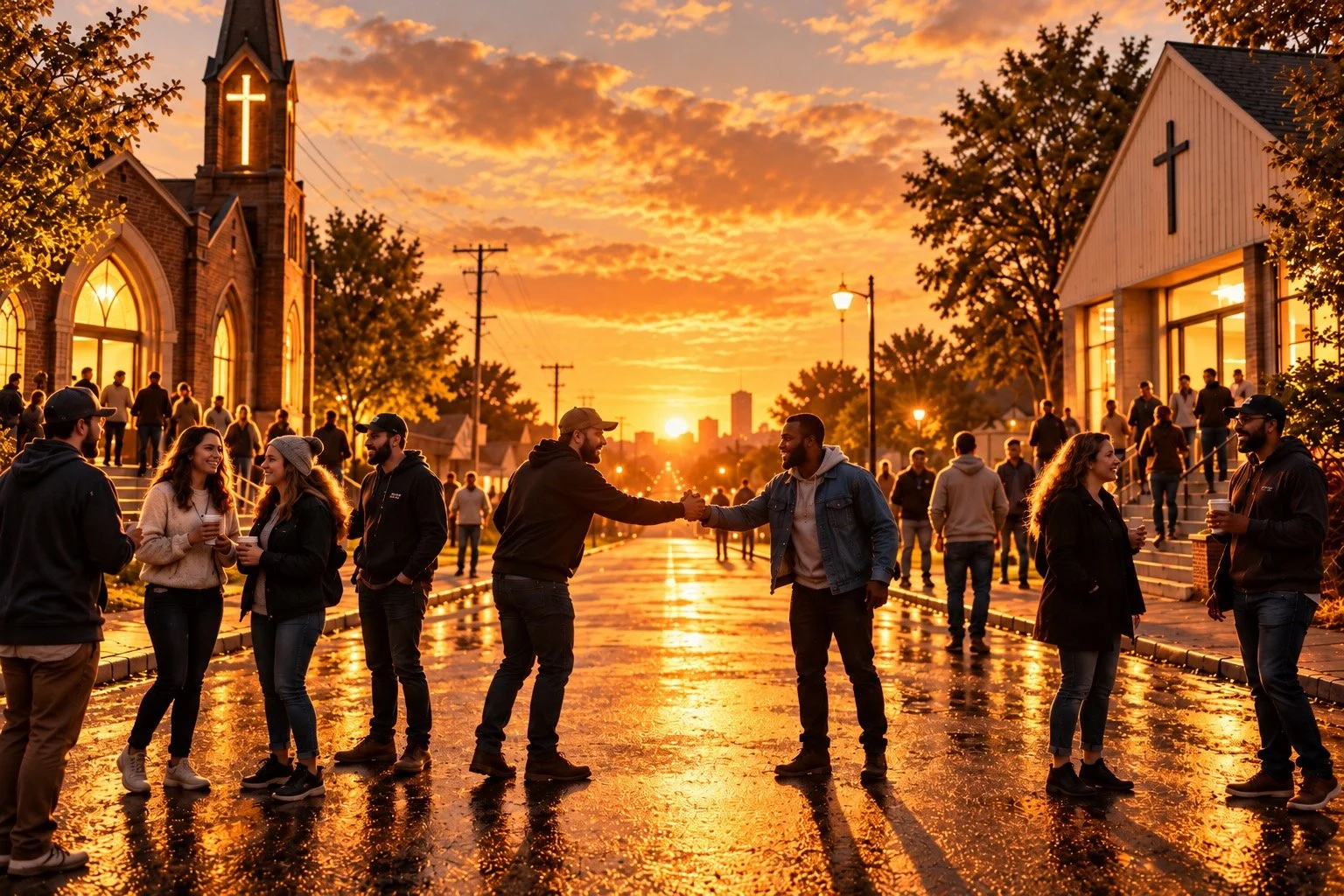
I love my church, and I think you should love yours too. Love the people. Turn up. Serve. Give. Pray. Invest in relationships. Stick around when things aren’t perfect. Don’t treat church like YouTube Shorts, endlessly scrolling through congregations looking for better worship, shorter sermons and coffee that doesn’t taste like it was filtered through an old sock.
Being committed to a local church is a good thing. But there’s a subtle difference between “I love my church” and “my church is better than your church.” Sometimes we cross that line without noticing.
We compare preaching, worship, theology, kids’ work and outreach. We become strangely interested in how many people go to the church down the road. We reassure ourselves that while they might be growing, our theology is definitely better. Before long, the church down the road starts feeling suspiciously like the competition.
And that’s a problem.
There’s Only One Church
Depending on how big it is, your city might have dozens, maybe hundreds, of congregations. But there’s only one Church. It isn’t yours. It isn’t mine. It’s God’s.
We obviously need local churches. So this isn’t an argument for floating around between six churches and calling yourself “Kingdom-minded” because you don’t fancy joining the setup rota anywhere. Im not advocating for some kind of Pick ‘n’ mix approach to church. Commit somewhere. Love somewhere. Serve somewhere. But remember, your family is bigger than the room you worship in on Sunday.
Paul writes:
“Now you are the body of Christ, and each one of you is a part of it.”
- 1 Corinthians 12:27
The body of Christ doesn’t stop at the front door of our building. There are brothers and sisters worshipping all across your city. Different buildings. Different songs. Different traditions. Some have guitars. Some have organs. Some have smoke machines. Some have absolutely no idea why anyone would want a smoke machine.
And somehow, Jesus loves all of them. If they belong to Jesus, they belong to the same Church you do.
Yes, Theology Matters
Let’s be real. There might be churches in your city where theology creates a genuine barrier. Christian unity doesn’t mean switching off your brain, pretending doctrine doesn’t matter or reducing Christianity to “we all like Jesus, so let’s not ask any awkward questions.”
Truth matters. If we fundamentally disagree about who Jesus is, whether he rose from the dead, the gospel, the Trinity or other truths at the heart of the Christian faith, we can’t just shrug and call it denominational diversity. There comes a point where meaningful Christian partnership isn’t possible. That is a deeply sad reality, yet denial of that reality doesn’t honour God.
But let’s not move that line every time somebody disagrees with us. Most differences between faithful Christian churches are secondary or even tertiary.
Believer’s baptism or infant baptism? Important. Not a different gospel. Complementarian or egalitarian? Important. Not a different Jesus. Charismatic or cessationist? Important. Still family. Premillennial, postmillennial or amillennial? Important to some of you. Completely baffling to several others. Organ or electric guitar? Somehow, by the extraordinary grace of God, we may yet learn to coexist.
Some differences might mean we couldn’t happily belong to the same local church. But “we couldn’t run one church together” isn’t the same as “we can’t have a relationship.”
Maybe we need to ask what our disagreement actually stops us doing. We might not share eldership or a teaching platform. But are we at risk of letting those things become an excuse for not doing the things God has called us to do together? Can we pray together? Eat together? Serve our city together? Encourage each other? Be friends across denominational boundaries?
Discernment means knowing the difference between a boundary we need to keep and a wall we never needed to build.
Sometimes we’ve built a six-foot theological wall topped with barbed wire when a small garden fence would’ve done the job.
When Loyalty Turns Into Tribalism
Here’s where it gets uncomfortable. Churches can be suspicious of each other. We worry about other churches poaching “our” people. We compare numbers. We want to be the growing church, the influential church, the exciting church.
And if numbers aren’t our temptation, Christians have invented plenty of more spiritual ways to compete. We’re the biblical church. The Spirit-filled church. The traditional church. The missional church. The church that really understands grace.
Competition can wear some surprisingly spiritual clothes.
Someone goes to another church’s event and we wonder whether they’re thinking of leaving. Another congregation announces twenty baptisms and our first thought is to wonder where all those people came from. Someone moves churches and it can feel slightly like they’ve transferred from Liverpool to Man United.
But they haven’t joined the opposition. There is no opposition.
If someone leaves my congregation and becomes rooted, discipled and loved in another faithful Christian church, I might genuinely miss them. But the Kingdom hasn’t lost anyone. They were never “ours”. They belong to Jesus.
What Does This Say About Jesus?
This matters because Christian unity isn’t just about everyone being nicer. Jesus prayed for it.
“that all of them may be one, Father, just as you are in me and I am in you… so that the world may believe that you have sent me.”
- John 17:21
Don’t rush past that. So that the world may believe.
Jesus connects the unity of his people with what the world believes about him. We tell people Jesus brings us back to God, breaks down walls, creates a new family and teaches us to love one another.
Then the Baptists, Anglicans, Pentecostals, Presbyterians, Methodists, Catholics, independent evangelicals and everyone else disappear into their own corners and occasionally wave politely at each other across the theological car park.
What are we saying about Christianity? And therefore, what are we saying about Christ?
Maybe one of the greatest demonstrations of the gospel isn’t Christians agreeing about everything. Maybe it’s Christians who disagree about some genuinely important things and still love each other, who partner in the gospel wherever they can.
Make Some Friends
So what do we do? Make some Christian friends who don’t go to your church. Actual friends. Not networking. Not recruiting. Not meeting for coffee while secretly wondering whether they’ll eventually realise your worship band is better and transfer across.
Go to a citywide prayer meeting. Support something another church is organising. Pray for another congregation. Celebrate their baptisms. Be genuinely pleased when they grow. If another church is doing something brilliantly, thank God for it.
You don’t have to start your own version. I know. Radical.
Building friendships with Christians from other congregations doesn’t weaken your local church. It strengthens the Church.
“The Baptists” become Dave and Sarah. “The Anglicans” become the people who prayed with you when life was falling apart. “That charismatic church” becomes the family who turned up when somebody needed help.
The theological differences don’t disappear. But unity stops being a big theological idea. It becomes a relationship.
Imagine What Could Happen
Now imagine those friendships spreading across a city. Christians praying together. Serving together. Supporting schools. Feeding people. Caring for the vulnerable. Sharing resources. Celebrating each other instead of competing.
Not because theology doesn’t matter, and not because everyone’s merged into one enormous beige megachurch where nobody’s quite sure what anyone believes and the statement of faith just says, “Be nice and don’t upset Brenda.”
Different churches can keep their convictions, leadership and distinctives.
We don’t need fewer churches. We need fewer walls between them.
Then imagine that happening town after town, city after city. Could that change a city? I think it could. Could cities like that start changing a nation? I think they could too.
Because when people see Christians crossing boundaries, loving each other, serving together and putting God’s Kingdom ahead of their own little corner of it, they catch a glimpse of something Jesus prayed for two thousand years ago: that they may be one.
So love your church. Serve your church. Give to your church. Pray for your church. Invest deeply in your church family.
Just remember that your church family meets in a lot more buildings than yours.
Many congregations. One church. One Lord. One mission.