
A while ago, I wrote an article called God Doesn’t Need, You But He Wants You based on a song I’d written called You Don’t Need. It was about a truth I find both deeply humbling and wonderfully freeing: God doesn’t need us, but He absolutely wants us.
Today, I felt compelled to reflect on another one of my songs. This one’s slightly older. I wrote it just under a year ago, and it’s called Let the Father Speak (Listen Here).
The song came out of something I’ve had to learn and re-learn more times than I’d care to admit: I am very good at asking God to speak while simultaneously making it almost impossible for me to hear Him.
I can pray, “Lord, would You speak to me?” and then give the Creator of the universe approximately twelve seconds before checking my phone. Nothing yet, Lord? Fair enough. Instagram it is.
But Let the Father Speak isn’t really a song asking a reluctant God to say something. It’s about learning to quiet a noisy, striving heart long enough to listen. Because God has always been a speaking God.
Perhaps the problem isn’t that He has gone quiet. Perhaps I’ve forgotten how to listen.
In the Silence of Surrender
The song begins:
In the silence of surrender
Where shadow meets the light
When I realise my battles
Are far beyond my might.
I hate having a problem in front of me. I want to solve it. Not necessarily in an organised, carefully considered sort of way. I’m much more likely to start trying to fix it immediately and work out whether I know what I’m doing somewhere along the way.
Waiting does not come naturally to me.
If something is wrong, I want to do something. If someone is struggling, I want to help. If there’s an obstacle, I want to find a way around it. If a door is closed, my first instinct is generally to give the handle another good yank before considering whether God might actually want it shut.
That’s why the next lines matter so much to me:
When I finally remember
All the work is Yours to do
I discipline my striving heart
And incline my ears to You.
There is a difference between obedience and striving. Obedience asks, “Father, what are You asking me to do?” Striving starts doing something and remembers to ask God somewhere around step six.
I’ve become remarkably good at asking God to bless solutions I never actually asked Him about.
Sometimes the discipline isn’t making myself do more. Sometimes the discipline is making myself stop. To acknowledge that I don’t have the answer, that some battles really are beyond my might, and that before I charge off trying to solve something that may not even be mine to solve, perhaps I should listen to the One who can actually see the whole picture.
Be Still and Know
The chorus says:
So I’ll be still and know You
Sit and rest at Your feet
And wait in holy silence
And let the Father speak.
Stillness feels increasingly unnatural.
When was the last time you were genuinely quiet? We drive with something playing, exercise with headphones in, cook while listening to podcasts and watch television while simultaneously looking at the smaller television in our hands. Apparently one screen is no longer sufficient.
Christians can do a spiritual version of exactly the same thing. We have sermons, worship playlists, Bible apps, podcasts, books, conferences and endless videos explaining what God apparently wants us to know today.
Most of those things are good. But there is something slightly ridiculous about asking God to speak while filling every available second with everybody else’s voice.
Psalm 46:10 says, “Be still, and know that I am God.”
Christian stillness isn’t about emptying our minds and hoping something mystical happens. It’s about becoming attentive to the God who is already there.
The chorus also deliberately echoes Mary sitting at Jesus’ feet in Luke 10. Martha is busy serving while Mary sits listening. I have some sympathy with Martha. I imagine her in the kitchen thinking, Lovely spiritual encounter you’re having there, Mary. Perhaps afterwards you’d like to experience the miracle of the washing up.
But Jesus says Mary has chosen what is better.
He isn’t condemning service. He’s confronting service that has become disconnected from presence.
That’s uncomfortable for those of us who serve in church, because we can become so busy doing things for Jesus that we forget to spend time with Jesus. As Andrew Wilson puts it, we can become so focused on all the things of God that we neglect the God of all things. We can preach about Him, lead people in worship to Him, attend meetings about His church and care for His people while slowly losing the intimacy from which all of that was supposed to flow.
Sometimes sitting at His feet isn’t avoiding the work.
It’s where the work needs to begin.
Your Voice Called Forth Creation
Verse two shifts the focus from our listening to the One we’re listening for:
Your voice called forth creation
Spoke light into the void
Your words are living water
That heal what sin destroyed.
The Bible begins with God’s voice: “And God said, ‘Let there be light,’ and there was light” (Genesis 1:3).
God speaks and darkness retreats.
Then Hebrews tells us that God’s revelation reaches its fullness in Jesus: “In these last days he has spoken to us by his Son” (Hebrews 1:2).
Jesus isn’t simply another messenger carrying words from God. He reveals the Father. And when Jesus speaks, things happen. Storms stop, demons leave, sins are forgiven, sick people are healed and dead men get out of graves.
That’s why the bridge declares:
One word from You
And everything changes.
God hasn’t lost His voice.
So how do we know when we’re actually hearing it?
How Do I Know It’s God?
This matters, because Christians sometimes say, “God told me…” with a level of confidence I normally reserve for my date of birth and whether I’d like another roast potato.
I believe God speaks today. The Holy Spirit leads, prompts, convicts, comforts and directs His people. Sometimes Scripture suddenly lands with extraordinary weight. Sometimes a thought or prompting persists. Sometimes another Christian says something without knowing how significant their words are. God can and does use prophecy, wisdom, circumstances and spiritual gifts.
But not every thought wandering through my brain has come directly from the throne room. A concerning percentage of mine these days are about food.
Scripture tells us to test what we believe we’re hearing (1 Thessalonians 5:19–21). The first and most important test is Scripture itself. God will not contradict what He has already revealed. The Spirit who inspired Scripture isn’t going to develop theological amnesia halfway through Tuesday afternoon.
We can also ask whether what we’re hearing looks like Jesus and produces godly fruit. Does it lead towards truth, holiness, love, humility and the fruit of the Spirit, or towards pride, bitterness, fear and selfish ambition?
And when it comes to significant decisions, particularly those affecting other people, bring trusted, mature Christians into the process. “God told me” should never become a spiritual trump card that makes us impossible to challenge.
Perhaps one of the healthiest phrases in the Christian vocabulary is, “I think God might be saying…”
God is infallible. I am not.
Jesus said, “My sheep listen to my voice; I know them, and they follow me” (John 10:27). We learn someone’s voice by spending time with them. The more soaked we become in Scripture, the more familiar we become with Jesus, and the more we walk with His Spirit, the better equipped we become to recognise the Father’s voice.
Not perfectly. But increasingly.
Lord, I’m Listening
The bridge eventually moves from declaring what God’s voice can do to a much more personal prayer:
I long to hear You speaking now
Fill my life with holy sound
Lord, I’m listening.
Those last three words might be the heart of the whole song.
Lord, I’m listening.
Not, “Lord, give me the answer I want.” Not, “Lord, confirm the decision I’ve already made.” Not even, “Lord, tell me what to do next.”
Just, “I’m listening.”
Because I wonder whether sometimes we approach God looking for information when the Father is offering relationship.
The prize of prayer isn’t information. The prize is God.
That’s why the chorus says, “I’ll be still and know You.” Not merely know what You want me to do. Not simply know the answer.
Know You.
Sometimes a child sits beside his dad because he needs something. But sometimes he sits there simply because that’s his dad. There doesn’t have to be an agenda. Sometimes presence is enough.
Maybe that’s something we’ve lost in all the noise.
Let the Father Speak
So perhaps we don’t need another seven-step technique for hearing God.
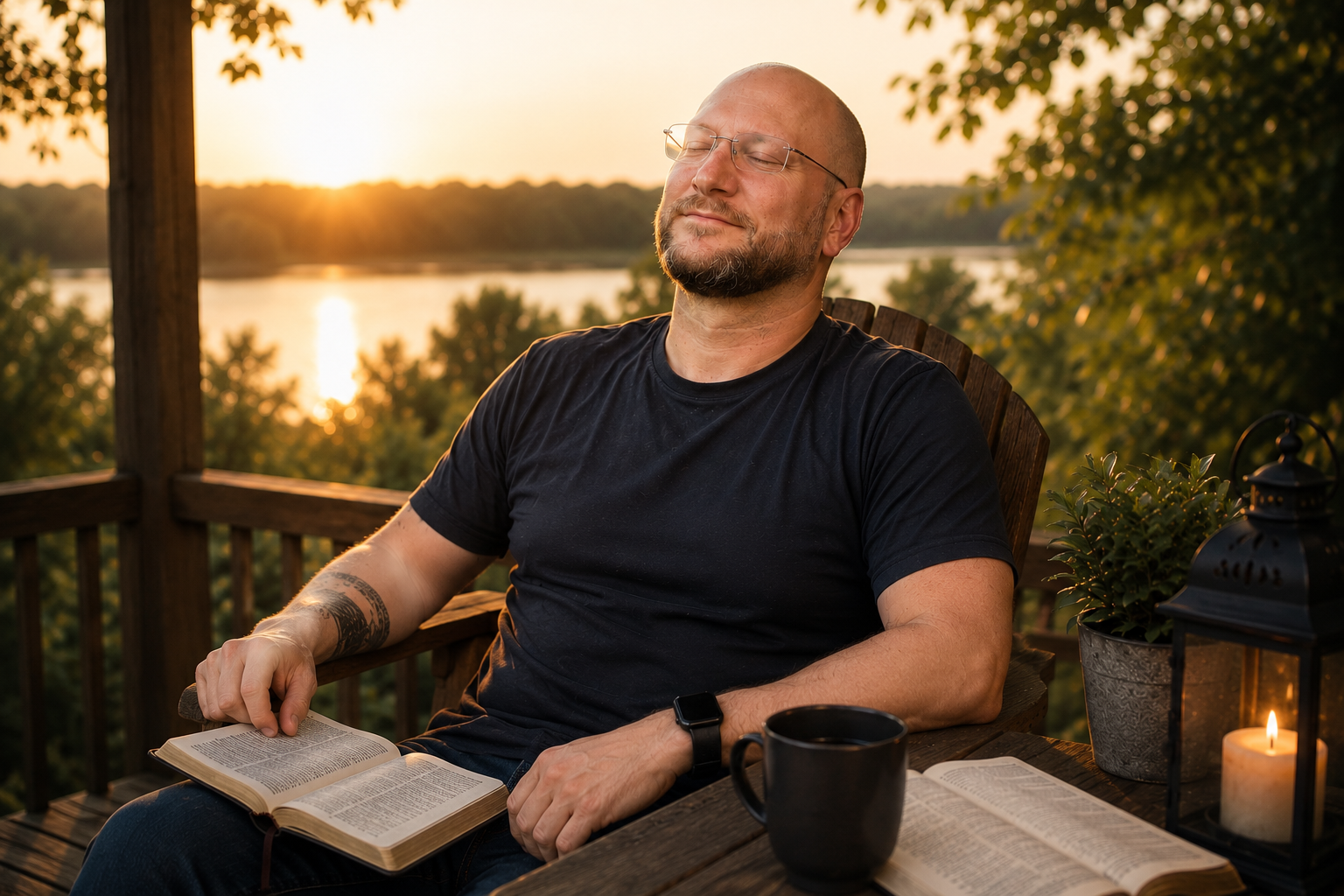
Maybe we need to put the phone down for a while. Turn off the noise. Open the Bible. Ask the Holy Spirit to illuminate His Word. Sit at Jesus’ feet and stay there for longer than twelve seconds.
Don’t manufacture anything. Don’t panic if lightning doesn’t flash and a booming voice doesn’t announce your five-year plan. Don’t assume every thought is God, but don’t become so frightened of getting it wrong that you stop expecting your Father to lead you either.
Just listen.
The Father who spoke light into darkness has not lost His voice. The Son who called dead men out of graves is still alive. The Spirit who inspired Scripture still lives within God’s people.
And underneath all our noise, striving, fixing, worrying and talking, perhaps the invitation remains wonderfully simple:
So I’ll be still and know You
Sit and rest at Your feet
And wait in holy silence
And let the Father speak.
Maybe the Father hasn’t stopped speaking.
Maybe we just need to shut up, let Him get a word in edgeways & rest in His presence?